
Have you ever heard a man speak and then say to yourself, “that guy is gay“?
I’ll admit, it’s something that has happened to me on both sides of the scenario: I’ve assumed someone was gay based off of their voice, and others have assumed that I am gay based off my voice.
In fairness, however, the people who judged me based off of my voice were somewhat correct. I’ve been married to the same man for four years, and we’ve been together since 2012. So, does that mean that it’s possible to know a man’s sexuality based off of the sound of his voice or the way he speaks? In this post, we find out.
What is the “Gay Male Accent”?
Let’s be stereotypical for a second. A “Gay Male Accent” or “Gay Voice” is one that is generally perceived to be a higher pitch than a heterosexual male’s voice, often with a lisp, and with a rather flamboyant or over-the-top intonation. It is also deemed to be “effeminate” and to mimic female speech patterns.
The reality is that accents exist on a spectrum and can be changed or enhanced in certain social situations. Some homosexual males exist who do not have a detectable “Gay Voice” at all, while others may have an accent that is deemed “over the top” or “especially effeminate.”
In my perception of my own accent, I do think that listeners can probably identify that I am not heterosexual. I mean, if you watched the video above, it’s evident that I don’t have a deep, baritone voice like stereotypical men do. However, I don’t think I have an overly flamboyant voice similar to that of a “Valley Girl/California” accent. Further, I do know that my voice changes–just like everyone’s does–depending on the social situation I find myself in. I tend to sound “more straight” in formal situations or among people I don’t know, but perhaps lean more into a “Gay Male Accent” in informal settings, especially those that include friends.
The Pitch of the “Gay Voice”
If we go back to the stereotype of a “Gay Male Accent” for a second, one of the supposed determining factors is a higher pitch of a gay male’s voice.
According to the research, gay males tend to have a higher voice pitch than straight males, but not all the time. In a 2011 study of the pitch characteristics of homosexual males published in the Journal of Voice, the average fundamental frequency and pitch variation were higher in homosexual males than in heterosexual males. That means that, on average, homosexual males’ voices were higher in pitch and also in the variation of their pitch. Further, a 2020 study of French men determined that homosexual males had voices with higher pitches in comparison to heterosexual males.
Other research, however, has disputed these findings and claimed that vocal pitch isn’t an accurate way to identify gay men at all. In fact, a 2003 study published by linguists at the University of Toronto determined that participants could only identify a man’s sexuality correctly 62% of the time based on the pitch of their voice. This suggests that heterosexual males can have high-pitched voices too, and the pitch of a male’s voice is not an accurate way to ascertain their sexuality. Moreover, a second study from the University of Hawaii found that participants were equally as likely to misidentify gay and straight speakers based on the pitch of their voice. In fact, some of the heterosexual men deemed “gay” by listeners weren’t even aware that they had a higher pitched voice at all.
The Gay Lisp

The second most stereotypical feature of the “Gay Male Accent” is the supposed lisp that gay males have. To be honest, I don’t think I have a lisp, but after listening to my voice on YouTube for over 10 years, I can concede that there is definitely something going on with my “s” sound.
According to research, apparently I’m right: there is something going on, but it’s not necessarily a lisp. According to researchers, what is perceived as a lisp in gay males is actually what is called hyperarticulation. Hyperarticulation is the process by which someone speaks very precisely and pronounces sounds very clearly. This results in a lengthening of the “s” sound as well as a very sibilant (loud) “s” sound. In fact, in the analysis of the pronunciation of “s” and “z”, gay males produced these sounds with higher acoustic peaks than straight males, accounting for a perceived lisp in homosexual males. Further, these articulations of the “s” and “z” sound are the most accurate indicators of gay male speech, according to the study presented at the Linguistic Society of America in 2008.
Vowels & Enunciation
A third supposed feature of the “Gay Male Accent” is the differences in vowel articulation as well as general enunciation of words and sounds. According to a 2006 study of gay men in the Upper Midwest of the United States, gay males lower the articulation of the vowel sounds in words like “trap” and “dress” in comparison to straight males. They also tend to “front” or bring forward in the mouth the vowel sounds in words like “goose” and “goat.” These features are stereotypical of a California or “Valley Girl” accent, but they have been documented in both females and straight males all across Western North America.
In terms of enunciation, there have been some correlations between gay males and what is termed “careful speech.” Apparently, homosexual males are more likely to speak clearly and over-articulate, resulting in changes to vowel and consonant sounds. I mean, if we look back at the hyper-articulation of the “s” sound in gay male speech, this claim doesn’t seem that far off.
So, Why Do Gay Men Talk Like That?
So, one thing seems clear: while there are some undeniable trends in “Gay Male Speech,” it is not possible to categorize all gay males as speaking one particular way. Any male, gay or straight, can have a high-pitched voice; a strident “s” sound; lowered, fronted, and lengthened vowels; and “careful speech.” That said, there is some science that seems to point to these features as being more likely in gay males, and perhaps perpetuates the stereotype that all gay males speak this way.
The question remains, why do gay males talk like that?
Well, the research is inconclusive, and it comes down to an age-old debate of nature vs. nurture. On the nature side, the suggestion has historically been that gay males have more estrogen (or other hormones) and less testosterone in their bodies than straight males, and that causes a higher pitched voice. That has since been disproven as the levels of estrogen and testosterone naturally vary from person to person and even during a single person’s life time.
Further, research published in The Journal of Clinical Endocrinology called “The Glass & Johnson Study” (1940) documented what happened when scientists supplied homosexual males with more testosterone to “combat the gay.” Let’s just say, it had some very unintended consequences. Instead of changing the sexual orientation of homosexual males, it simply increased the intensity of their urges. In short, this proved that there is no relation between the level of certain hormones in the body and someone’s sexual orientation. This can thus be extended to a gay male’s voice: a high-pitched voice, whether caused by certain hormones or not, has little bearing on their sexuality.
On the nurture side, it was once believed that gay males spoke the way that they do to deliberately imitate female speech. This would result in gay males being more socially accepted among women as well as more accepted in the gay community at large. I don’t know if there is any research on this–I couldn’t find any–but on an anecdotal level, I don’t think this is true. For starters, I don’t ever remember consciously choosing how I speak, much less trying to imitate female speech patterns. Secondly, I often tried to change my voice and the way I spoke in my teenage years because I was concerned that I “sounded gay.” So, to say that gay males speak this way to be more socially accepted around women and the gay community at large wouldn’t apply since I was deliberately trying not to talk this way.
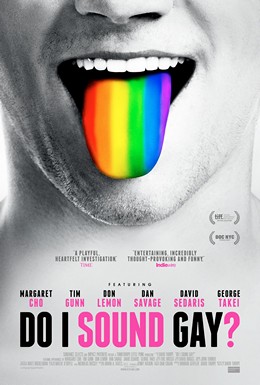
My experience is in contradiction to some other homosexual males, however. For example, in the documentary film “Do I Sound Gay?”, David Thorpe apparently intentionally changed his voice at age 17 when he came out and wanted others to know he was a homosexual. I’m not quite sure how he forgot about doing that and then needed to make a documentary about it, but I guess to each their own.
Now I ask you: what do you think? Do you believe there is a “Gay Male Accent”? What are your perceptions of its features and why is it used? Leave me a comment!


Leave a Reply