
What do Madagascar, New Zealand, and Hawaii all have in common?
Besides being islands, they all speak languages from the same language family that originated in Taiwan.
Enter the Austronesian language family. Spread by seafarers, languages like Indonesian, Tagalog, and even Malagasy developed through 5000 years of Austronesian migration. But wait! It gets better: did you know that the first humans didn’t arrive in New Zealand until 1200 CE? What does that fact have to do with Austronesian languages? Stay tuned…
The History of the Austronesian Language Family
The history of Austronesian languages dates back thousands of years, and it begins in a place that you may not expect: Taiwan. While human habitation of Taiwan itself dates back at least 20,000 years, things looked quite different back then. In fact, Taiwan wasn’t the island we know it as today; rather, it was connected to the mainland by a land bridge that allowed peoples and goods to migrate with ease. That all changed around 8000 BCE when the ocean rose, separating Taiwan by 160 kilometers of sea, and the Austronesian language family was born.
The Austronesian languages are thought to have descended from a common ancestor language, known as Proto-Austronesian, which was spoken by early Taiwanese inhabitants between 4500 and 3500 BCE.
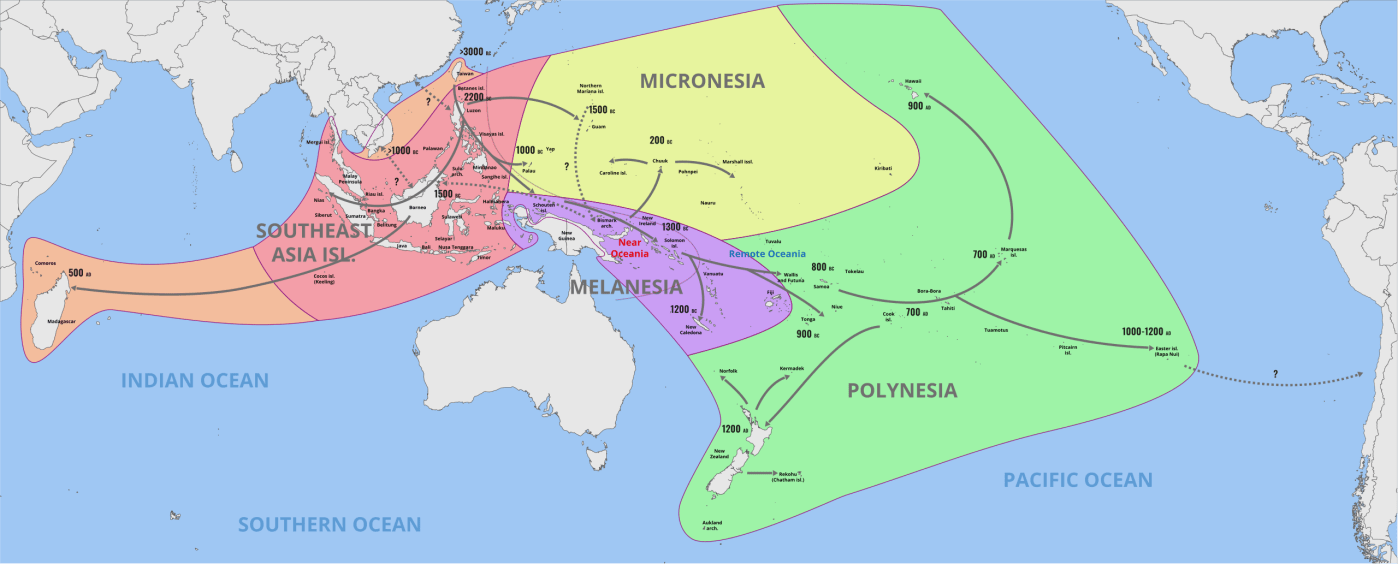
Between approximately 3000 and 1500 BCE, Austronesian-speaking peoples started to migrate from Taiwan into the Philippines, arriving in Luzon in the north and continuing southward. Austronesian peoples used a technique known as “island hopping” to explore and settle new areas by successively moving from one island to another.

These early seafaring settlers established communities along coastal regions, relying on fishing, agriculture, and trade, and they brought with them advanced knowledge of boat building, navigation, and agricultural techniques. What inspired this migration is unknown; however, some researchers suggest population growth and a bid for resources. There were already human inhabitants on some of the islands that they settled (such as in the Philippines), but evidence suggests that Austronesian peoples intermingled with the pre-existing populations, and their culture and language dominated.
Between 1500 and 1000 BCE, Austronesian-speaking peoples expanded further into Southeast Asia, navigating across the Indonesian archipelago. This expansion spread Austronesian languages across the Indonesian islands, including Java, Sumatra, Borneo, and Sulawesi.

Eventually, Austronesian speakers ventured further eastward and westward into the Pacific and Indian Oceans. Amazingly, some even reached remote places such as Madagascar in 500 CE, Hawaii in 900 CE, and Easter Island in 1000 CE.
In fact, Austronesian peoples were the first humans to settle the far reaches of the Pacific. For example, it is believed New Zealand was uninhabited before the first Austronesian speakers arrived in 1200 CE. For context, the arrival of humans on New Zealand takes place just before the Black Death decimates parts of Europe and North Africa and a mere 350 years before the Dutch navigator Abel Tasman charted the North Island on a sailing expedition.
Lastly, there is even some loose to suggest that Austronesian peoples may have reached the western coasts of South America based on the spread of the sweet potato. This link is not fully supported by scientists at this time.
The Austronesian Language Family Today
Due to the impressive migration of Austronesian peoples, their languages have spread to a large part of the globe. In fact, with over 1,200 languages, the Austronesian language family is second to only Niger-Congo languages by number of languages.
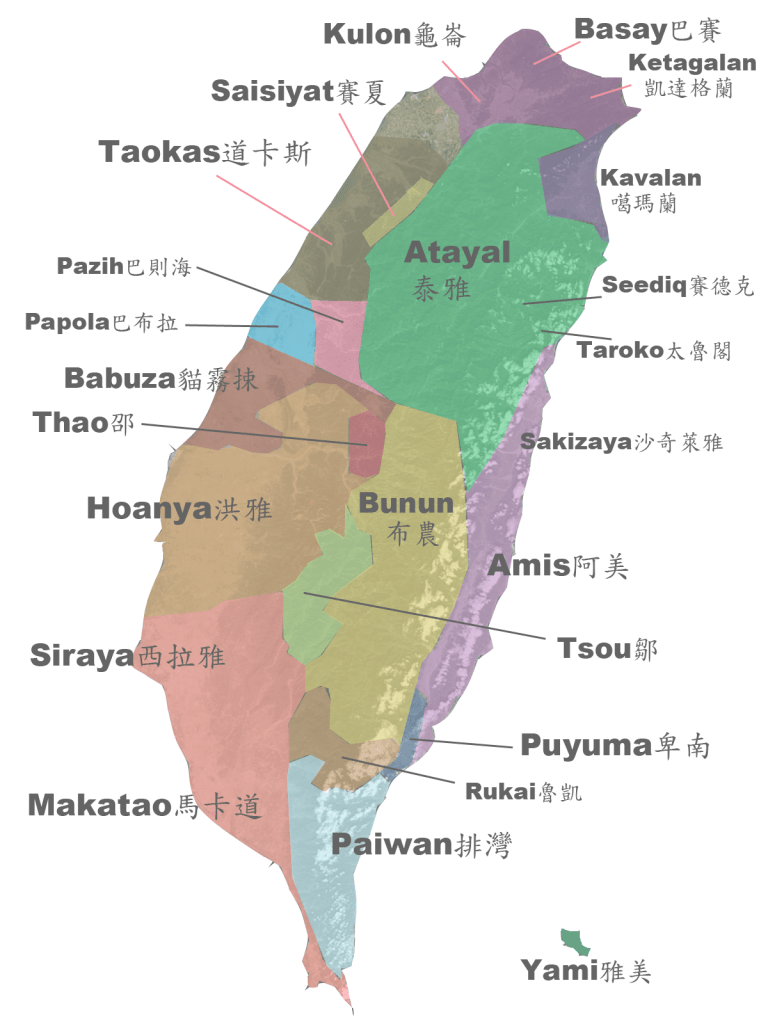
Further, Austronesian migration helped the language family branch into different subgroups. These include as Malayo-Polynesian, Western Polynesian, Central-Eastern Malayo-Polynesian as well as the Formosan languages that are spoken by the indigenous people of Taiwan. These languages are critically endangered on Taiwan, being replaced by Mandarin.
Today, the most spoken Austronesian languages include:
– Indonesian with approximately 270 million speakers. It is primarily spoken in Indonesia.
– Malay, spoken by around 77 million people. It is the official language of Malaysia, Brunei, and Singapore.
– Javanese, spoken by about 98 million people, primarily in the Indonesian island of Java.
– Tagalog, spoken by around 45 million people. It is the official language of the Philippines.
– Sundanese, spoken by approximately 39 million people primarily in the Indonesian province of West Java.
– Cebuano, spoken by 32 million people in the Philippines.
Other languages in the Austronesian family include Maori, Ilocano, Hawaiian, and Hiligaynon. The Malagasy language, spoken in Madagascar, is also an Austronesian language.
Linguistic Features of the Austronesian Language Family
As with any language family, Austronesian languages have some unifying linguistic features. One distinguishing characteristic is their extensive use of reduplication, which means that a word or a part of a word is repeated or duplicated to modify or created a new meaning. For example, in Tagalog, the word “Ganda” means “beauty.” When reduplicated as “Ganda-gandang,” it intensifies the word, translating to “very beautiful.”
Furthermore, Austronesian languages commonly employ a subject-verb-object (SVO) word order. This is similar to Indo-European languages like English.
Austronesian languages generally have a relatively small number of consonant phonemes and a larger number of vowel phonemes. Some languages, like Hawaiian, only have a small set of consonants in comparison to the number of vowels.
Many Austronesian languages also exhibit a focus on verbs rather than nouns. The verbs often mark grammatical tense, aspect, and mood through affixation or other morphological changes. This is in contrast to languages like English which have a relatively low level of verb inflection.

Most interestingly, Austronesian languages also exhibit clusivity. This refers to whether the first-person plural pronoun (“we”) includes or excludes the person being spoken to. For example, in Malay, there are two words for the English concept of “we.” The first word is “kita” which is the inclusive form that refers to the speaker and the person being spoken to. The second word is “kami” which is the exclusive form that refers only to the speaker and some unknown other persons. The “kami” form never includes the speaker being spoken to. It is notable to mention, however, that “kami” is falling out of every day usage in Malay, and “kita” is becoming both the inclusive and exclusive word for “we.”
Austronesian languages, although fascinating, have also had an influence on the world stage. With a population of over 385 million native speakers, Austronesian languages have influenced other languages. For example, the words “bamboo,” “pangolin,” and “sago” are Austronesian words borrowed into the English language.

Interested in learning an Austronesian language? Check out uTalk today and get 20% off!
 The Polyglot Files


Leave a comment